
HOW IT WORKS
Brand fundamentals
and the four questions
that build every strong brand.
A brand is not your logo. Branding is not your strategy. And brand strategy is not a luxury. Here is the framework I use to help nonprofits, startups, and small businesses get clear about what they stand for — and what they want to be known for.
BRAND FUNDAMENTALS
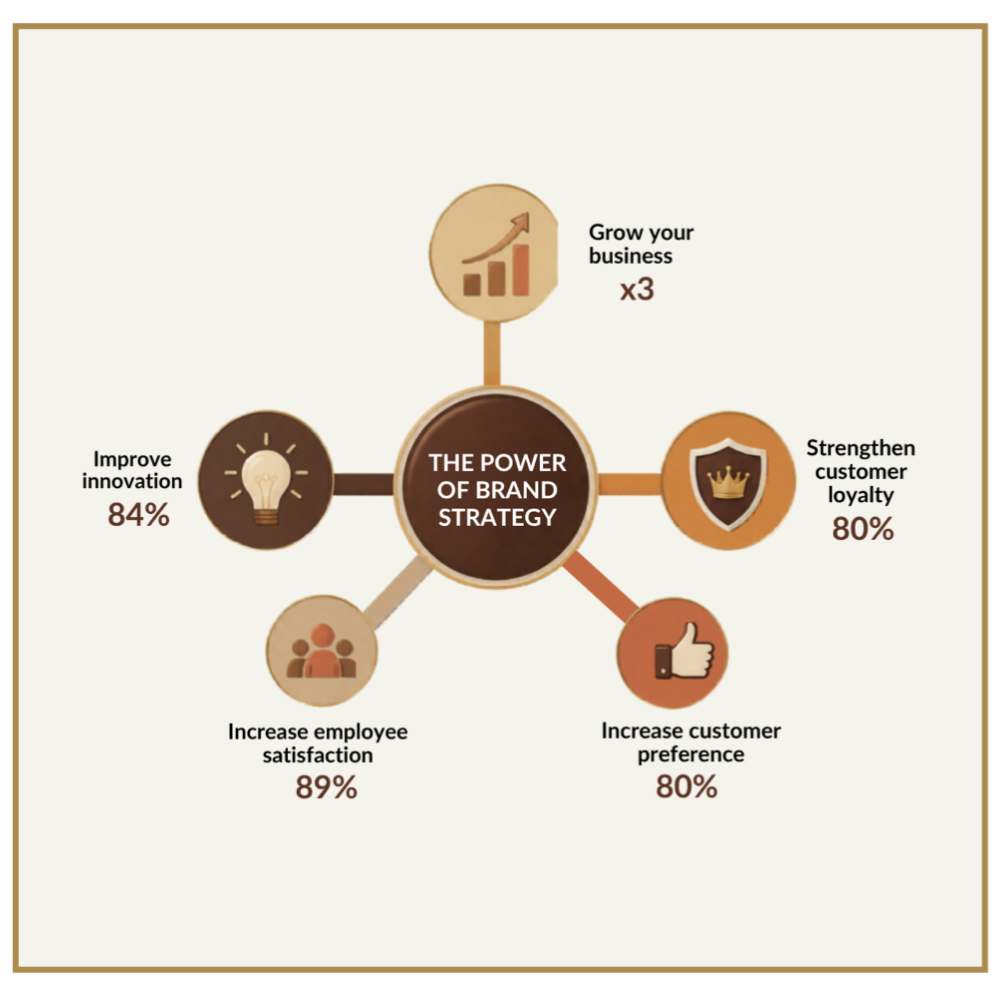
The power of brand strategy is not theoretical.
Brands built on a clear strategy do not just look more consistent — they grow faster, command more loyalty, attract better talent, and earn the trust of the customers who matter most. Research across thousands of organizations keeps pointing in the same direction.
The numbers in the diagram are not aspirational. They are the measurable lift that organizations consistently see when their brand strategy is in place.
Sources: Jim Stengel 10-year growth study; PwC Purpose research; EY/HBR The Business Case for Purpose; Marketing Week brand-equity reporting.
THE FRAMEWORK
Every brand strategy
is built on four questions.
Brand strategy is your decision about what you want to stand for and the associations you want to build in people's minds. You get there by answering four questions — in order. WHY first, WHAT last. Skip any of them and the foundation will not hold.
Question 01
The ultimate value you provide. The cause your team comes to work for. People do not buy what you do — they buy why you do it. Everything else traces back to this one answer.
Question 02
Your values, principles, philosophy — the culture beneath the work. This is what helps you identify the right people to attract, hire, and serve, and what tells you who isn't a fit.
Question 03
Two parts. The behaviours and standards that guide your team. And the verbal, visual, and sonic cues that tell creative partners how to bring your brand to life consistently.
Question 04
Your products, services, experiences. Most organizations mistakenly start here. Done last and done creatively — McDonald's is not a fast-food chain, it is an "informal eating-out chain" — this answer can reframe how you stand out.
CONCEPT 01
What is a brand?
Walter Landor, the founder of one of the world's largest and oldest brand consulting firms, said it best:
"Products are made in the factory, but brands are created in the mind."
WALTER LANDOR
When you think about whether you prefer Audi or BMW, Starbucks or Costa, Apple or Microsoft, your decision is not coming from a spec sheet. It is coming from associations, feelings, and beliefs you already hold about those names.
A brand is the sum of associations a person has built up in their mind about you over time. The stronger and more connected those associations are, the more likely they are to choose you. Neuroscience research by IPSOS across 1,300 consumers showed that the denser the mental network for a brand, the better the recall — and the larger its market share.
This is why job number one is not designing a logo or picking a colour palette. It is deciding what you want those associations to be. That decision is your brand strategy.
Brand strategy is your decision about what you want to stand for and the associations you want to build in people's minds. It is what you do before you write the website, design the logo, or post on social media.
The output is not a deck. It is a working document that answers the four questions — WHY, WHO, HOW, WHAT — in your team's own language, with enough specificity that any new hire, board member, or creative partner can use it tomorrow.
→ WHY you exist— your purpose or mission. The ultimate value you provide.
→ WHO you are— your values, principles, philosophy. Your culture.
→ HOW you do things— your behaviours and standards. Plus how you look, feel, sound.
→ WHAT you do— your offer. Defined last, defined creatively.
The labels do not matter. Whether you call WHY a "purpose," a "mission," a "north star" — the content of the answers is what counts. What matters is that you answer all four.
CONCEPT 02
What is brand strategy?
CONCEPT 03
What is branding?
If brand strategy is the decision, branding is the signals — the way you express that decision so it actually reaches people. Branding reinforces the associations you decided to build.
These signals come in four families::
Visual signals
Logo, colour palette, imagery, packaging, shapes, patterns, typography.
Verbal signals
Name, nomenclature, tone of voice, brandline, the language you use.
Sonic & sensory signals
Chimes (T-Mobile, Intel), bespoke fragrances in luxury lobbies, signature textures.
People & characters
Jennifer Garner for Capital One gerge Clooney for Nespresso, The Gecko for Geico Insurance.
Together these signals form your brand identity. Most companies start here — and end up with a polished identity that does not reinforce anything in particular, because there is no strategy underneath it.
CONCEPT 04
Why you need brand strategy.
Brand strategy answers the four questions before branding starts. That makes it the foundation you judge everything else against — your identity, your messaging, your hiring, your product decisions, your fundraising.
But its impact reaches further than visual consistency. Brand strategy is the lens you use for customer engagement, employee engagement, and innovation. It tells you what to invest in and what to walk away from.
"There's no shortage of great ideas at American Express. But what stops great ideas from coming to life is having a lens to evaluate what should be invested in and what should not. This is where the brand becomes crucial — it sets our filter for innovation."
CLAYTON F. RUEBENSAAL III, AMERICAN EXPRESS SVP OF GLOBAL BRAND MANAGEMENT
If your team cannot evaluate a new idea against a clear answer to WHY you exist — you do not yet have a brand strategy. You have a brand identity, which is something different.
THE EVIDENCE
What happens when organizations actually do this work.
Consumers want a shared purpose.
63% of consumers prefer to buy from companies whose purpose reflects their personal values and beliefs.
Accenture, Global Consumer Pulse Research
Purpose multiplies trust.
Consumers are four to six times more likely to trust, support, or champion brands that demonstrate a strong sense of purpose.
Zeno Group, 8,000 consumers across 8 countries
Employees show up for meaning.
83% of employees say a sense of purpose gives their day-to-day work meaning — translating into retention and recruitment leverage.
PwC, 1,500 employees + 500 business leaders
Purpose drives loyalty.
80% of executives say organizations with shared purpose command greater customer loyalty than those without.
EY / Harvard Business Review, The Business Case for Purpose
Stronger employee satisfaction.
89% agree that organizations with shared purpose see higher employee satisfaction — the cultural compound interest of clarity
EY / Harvard Business Review
Transformation succeeds with it.
84% say business transformation efforts are more successful when integrated with a clear sense of purpose at the centre.
EY / Harvard Business Review
THE 10-YEAR GROWTH STUDY
Brands driven by a sense of purpose collectively outperformed the S&P 500 by almost 400% — and grew three times faster than their competition.
JIM STENGEL, FORMER GLOBAL MARKETING OFFICER, PROCTER & GAMBLE (2001–2008)
400%
This is the work we do together.
The four questions are simple. Answering them well is not. If you want a focused, rigorous look at where your organization stands — and what one clear next step looks like — start with a free 30-minute conversation.
No commitment required. Just clarity.